Showing posts with label Season extension. Show all posts

Friday, January 17, 2014

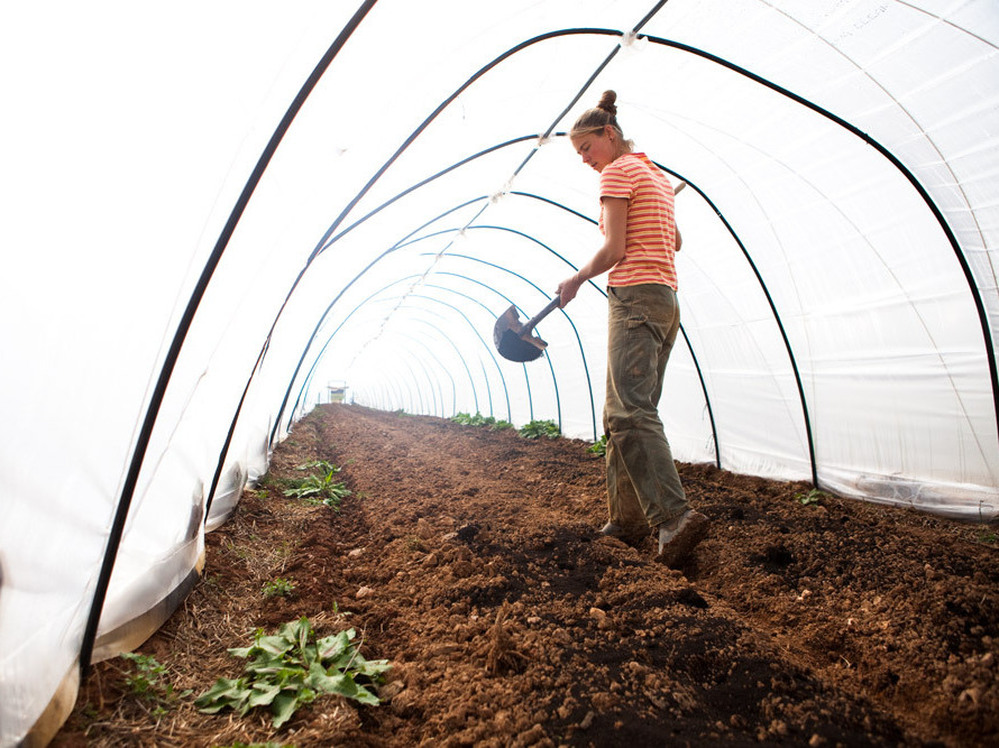
Winter Caterpillar Tunnel Structural Trial (2011)

In March 2011, we tested our caterpillar tunnel under heavy snow load to see how the structure would respond. Now that winter is upon us, we're re-posting our results from the trial. Let us know your thoughts on our findings by leaving a comment under this post!

Goal: To see if either caterpillar tunnel version (with, or without purlins) could withstand winter snow load.

Results: Very interesting. We picked two of the four tunnels that were built in May, 2010, planted onions in them, and buttoned them up for the winter. Both tunnels were structurally the same, with a center ridgepole made of chain link fence top-rail, but one of them also had purlins about three feet from either side of the ridge. These purlins, were used in the summer to trellis vine crops, and carried that load quite well. They really stiffened up the whole structure. However, in summer, they tended to cause the plastic to collect rainwater. This made me think that the purlins would either make it so strong that it would better carry the snow load or they would catch more snow than the tunnel without purlins and cause a collapse. It looks like the latter is the case.

Summary and recommendations: It is important to note that we intentionally did not remove snow in this trial, as we were looking for structural failure in worst case conditions. Removal of snow, even just next to the tunnel that failed, probably would have prevented its failure. Doing so would have greatly reduced the pressure bearing in on the sides (and therefore the plastic's weight felt on the top). If you intend to use a structure like this to overwinter crops in northern climates where snowfall is a concern, I would recommend a maximum of four foot bow spacing during construction, not using side purlins in winter tunnels because they catch snow, and, of course, the removal of snow whenever possible from the sides and top of the tunnel. It would also be prudent to shore up the bows internally with notched two-by-fours placed vertically under every other bow as a means of additional snow load insurance and peace of mind.

You can view the complete gallery of this trial below:


The 26-page illustrated manual for the bender used to make these tunnels may be downloaded on the Quick Hoops™ High Tunnel Bender's product page.


Adam Lemieux
Johnny's Tools & Supplies Manager

Friday, October 11, 2013

The Return on Investment for Greenhouse Cucumbers

Here at Johnny's, we are often asked about the return on investment (ROI) for greenhouse crops. Seed for greenhouse varieties is typically priced higher than seed for field-grown varieties, and in this case we believe you get what you pay for. The breeding and development of protected-culture varieties is more specialized and involved, and the return should be sufficient to justify the extra investment required on the part of the breeder as well as the grower.

If what you really want to know is, Why so much more money for this greenhouse variety?, Andrew Mefferd, former Product Technician for cucumbers here at and a seasoned greenhouse grower himself, has some answers for you.

'Excelsior' Cucumber
'Excelsior' Cucumbers

Higher Yields
  • Bottom line, ROI and profitability will typically be higher for greenhouse cucumbers than field-grown cucumbers. One key reason is because yields from greenhouse cucumbers are higher as a result of the optimized growing environment. In particular, it’s warmer, so plants grow in their optimal temperature range more of the time or even all of the time.
  • If you harvest just one more pound of cucumbers from a greenhouse variety than you would from a field variety, the seed will have paid for itself. Because you can ask a higher price for greenhouse crops at market, selling even just one extra fruit can sometimes cover the cost of the seed investment.
  • Greenhouse varieties are higher yielding because they are selected for the specific environmental conditions within greenhouses and hoophouses. They are, for example, selected for resistance to diseases that can be problematic in protected culture. This allows them to stay healthier and produce over a longer period of time within that environment.
Greater Control of the Environment
  • Within the greenhouse environment, plants are provided not just more optimal temperatures but also optimal water through irrigation, rather than being reliant on rainfall, which can set plants back when there is too much or not enough.
  • Pests can be minimized in the greenhouse with the use of preventive measures such as insect screening and trellising. Ground insects or slugs that might feed on field cucumbers will not typically crawl up a plant to feed on fruits that are elevated off the ground. When you have fewer plants damaged by pests, you’re left with more marketable crops to sell.
  • It’s important to note that greenhouse varieties often have better flavor because produce from a sickly plant that is inadequately photosynthesizing is just not likely to taste as good as produce from a healthy, greenhouse-grown plant.

'Socrates' Cucumber
'Socrates' Cucumber

Higher-Quality, More Diverse, Premium Product
  • A greater range of cucumber varieties can be grown indoors than outdoors. These include long, European types and more of the seedless, thin-skinned types. One key reason for this is because they’re protected from bugs indoors, which is especially important for seedless, thin-skinned types, which are more susceptible to pests due to their thin skin.

Crop Cycle Time
  • Greenhouse cucumbers are relatively quick to start bearing. Some early varieties can start yielding fruit as early as 45 days after being transplanted.
  • As noted above, cucumber plants also live much longer in the greenhouse than in the field. A field-grown crop might bear for one month before the plants get tired out, and disease and pests take over, whereas it is more typical for greenhouse cucumber crops to last several months.

Other Considerations
  • For greenhouse growers at high latitudes (like those of us here in Maine), it’s important to note that it can be very challenging to grow cucumbers through the winter — but it can be done. They require a lot of heat and also require supplemental lighting. Even without lights, however, your cucumber season can be extended well beyond the beginning and the end of the typical field cucumber season.
  • Lastly, it is important to research which varieties your market wants most. If what your markets demand are slicers or slender, Japanese cucumbers, be sure to grow those, rather than focusing efforts on picklers or the long, European types. Time spent researching your market will pay off, when it comes to bottom-line ROI.
We hope this helps you evaluate the potential return on investment for greenhouse cukes. For additional information, visit Johnny’s website: 

Leave us a comment — we are interested in your questions and comments about growing greenhouse cucumbers!

Friday, September 27, 2013

Create Tunnel Hoops Quickly & Easily


Extend the growing season for cold-hardy crops with a very late season harvest, or overwinter them for earliest possible spring harvest. 

Benders allow you to do this by creating low tunnel hoops out of galvanized electrical conduit. 


Tuesday, May 22, 2012

Customer photos: Mulch

Rick Kelley, a self-described “pepper-head” from Greenfield MA recently wrote in to tell us about his experience using Johnny's mulch. 

Rick says, "I planted about sixty chiles, eggplants and tomatoes into ground covered by it on Monday of last week, then covered it with a low hoophouse, and the plants have been loving it."

"I started the seed in early February indoors under lights so they got a good start, but they needed to go into the ground, and your product made that possible."


Friday, May 18, 2012

Small Equipment Demos at Tuckaway Farm

On May 15th, NH territory sales rep Chris Hillier and I traveled to Tuckaway Farm in Lee, NH (Seacoast area) to do a presentation organized by NOFA NH called ‘Small Equipment Demonstrations for Vegetable Farmers - Part II’. We were not involved in Part I, which was centered around larger equipment. When we first got there around 12:30 p.m., we met owner Chuck Cox, who showed us to the plot where we would be building a demo tunnel. We got to work right away setting up a 12' x 28' caterpillar. By 3:30, we had it ready to show. 


We then set up the bender demo area with a picnic table we had brought from Maine. Since the weather was iffy, we assembled the hand tools and seeders on a hay wagon, so that we could quickly bring them in the barn in the case of a torrential downpour.


Around 4:30, people started showing up. There were probably around 35-40 attendees with and without umbrellas. As they made their way in, we had kind of a free-for-all with the hand tools, as they got to try them out in a weedy patch of the field and express which were their personal favorites and why. A little after 5:00 Ray Conner, the Beginner Organic Farmer Program Director from NOFA NH welcomed everyone, and got the show started.

Chris went first, giving a brief overview of all the hand tools and seeders, with a promise to answer any specific questions after. This was great because she gave a very quick, comprehensive overview of the lines, what is available, and what the products’ individual strengths are.

Then Chuck gave his presentation, which started with some of his favorite hand tools, including a stirrup hoe, an old auto-feed jab planter, and a Planet Jr. seeder. He then moved on to some of his innovations, like his fencing cart, his row markers, garlic dibble, and his low cost solution for homemade Hotkaps. He finished up by demonstrating a horse-drawn spring tine weeder, which is used to remove small weeds in established crops. As he says, “Just don’t look back.”

Chuck Cox
After that, everyone assembled on the hill for the caterpillar tunnel demo. I started by bending a 6 ft hoop for low tunnels, then a hoop used to make high tunnels. We then moved over to the tunnel plot. I spoke about what we had done this afternoon to get the tunnel to the state that it was in. I enlisted some help from the crowd to insert and connect the last bow, cut the protruding ridge pole off, and then skin and lace the tunnel. 


All the while, what started out as drizzle got more and more steady. By the end of the talk, we were pretty soggy

Presenting in the rain
After that Dorn Cox, who is a board member for the National Young Farmers Coalition, gave a brief invitation for everyone to check out their affiliated site, Farmhack.net for innovations in tool designs.

Finally, we invited everyone inside the tunnel and drew names for the raffle.
Our raffle ticket winners
We intend to repeat this same talk on August 1st at Alchemy Gardens in Shrewsbury, VT. The talk will tentatively be held from 4:00 to 6:00 and will be presented through a collaboration of NOFA VT and RAFFL (Rutland Area Farm and Food Link). 

Hope to see you there! 
Adam. 

Adam Lemieux 
Tools & Supplies Manager

Wednesday, May 2, 2012

Broadturn Farm High Tunnels Project

I first met John Bliss and Stacy Brenner when I was researching the viability of the Paperpot Transplanter. While this product did not make it into our line (for logistical reasons), they are big proponents of it and have integrated its use throughout their overall planting strategy.


Their farm is heavily into agritourism and is just a little bit of everything. Quoted from their website:
 "Broadturn Farm is a CSA (Community Supported Agriculture) farm located 10 miles from Portland, Maine that raises organic vegetables, cut flowers,  strawberries, a small amount of poultry, and turkey, as well as natural lamb and pork. We host weddings and events. The property is in agricultural conservation with the Scarborough Land Conservation Trust. Formerly called the Keith Meserve Farm, the land is one of the largest farm properties in the Greater Portland area. It has 100 acres of open land and about 330 wooded acres."

Along with the CSA and weddings, they also run a farm stand called Flora Bliss, do wedding flowers and cut flower design for events, and have a farm camp in summer. Am I missing anything? Probably. They've got a lot going on.

The construction of caterpillar tunnels at Broadturn Farm was initiated due to a partnership involving offsite trialing of flower varieties for Johnny's Selected Seeds. I was asked to support this partnership by managing the construction of a caterpillar tunnel on their farm. I saw this as a unique opportunity to develop instructional videos for our Quick Hoops Bender line, so we decided to build a fixed tunnel and a moveable tunnel. The end goal would be making these videos available for free download on our website. We still have some minor filming and a bunch of editing to do, but we hope to get these videos out to the public soon.

This was every bit a trial as any of our projects have been, as both these tunnels were much longer than those we had previously built. Extra length brought with it some unique challenges, including the need for more secure T-posts at the ends of the tunnels and a need for more hands to hold down the plastic when skinning the tunnel. I also took this opportunity to try out some design modifications, which included building the fixed tunnel on taller ground posts. This really changed the structure substantially in size, feel, and thermal performance, and instantly made it accessible with a small tractor. This was (as always) a great learning experience, and we were able to accomplish this with two days of pre-fabrication in the Johnny's trial farm shop, followed by three separate days of on-site construction.

Special thanks to the Broadturn Farm Crew, including owners Stacy Brenner, John Bliss, Emma, and Flora, and their great crew, Andrea, Maggie, Clint and Nick. Thanks to Johnny's employees Jeff Young, Matt Giroux, Russel Prime, and Hillary Alger for their hard work in the construction of the tunnels. Thanks also to Angela DiMillo for her work behind the lens, and to Patti Lennon and Christina Hillier for their support on this project as well.

Adam Lemieux
Tools and Supplies Manager

Friday, April 20, 2012

Winter Growing Survey Contest Winner Announced

Jon and Debbie Butts of Ecofarm in Plant City, FL have been randomly selected as the winner of Johnny's Winter Growing Survey contest. The Butts have won a $50 coupon to Johnny's.

Ecofarm is a small, sustainable family farm that grows a variety of winter and summer produce. According to Debbie, they have had "great results from Johnny's seeds--especially some of the lettuces ('Cherokee', 'Green Star', 'Coastal Star', etc.) and kales ('Redbor', 'Winterbor', 'Toscano', etc.) that have performed well through this exceptionally warm, dry spring."

Jon and Debbie are also members of the Southwest Florida Small Farm Network (SWFSFN) and host a Sustainable Living Show on local Community Radio, WMNF 88.5FM in Tampa, where they often share sustainable gardening information with the public.

Friday, April 6, 2012

Protect Your Investment, Increase Yields with Mulch and Row Covers

Black Plastic Mulch is layed down prior to planting heat-loving crops like peppers and tomatoes.

Agribon Row Cover being applied over Quick Hoops™ Low Tunnels.

There are many uses for mulch and row covers this time of year when you're getting ready to plant. Mulch and row covers are economical and easy to use. You can sometimes get more than one season out of them if you're careful when you put them away in the fall.

Start with laying down some mulch. It will help suppress weeds, retain moisture, warm or cool the soil (depending on material and color), and repel insects.

Combining mulch with row covers will really optimize your growing conditions. Row covers help capture warmth and protect young plants from damaging winds and light frosts. Row covers are also the most effective and least toxic form of insect control that we know of.

Here are a few tips on using row covers from Paul Gallione, Johnny's Technical Services Technician, which were recently published in the "Away To Garden" blog.

Visit our website to shop for Mulch and Row Covers.

Friday, February 24, 2012

Eliot Coleman's Organic Farm, Winter Growing Subject of New York Times Story

Yesterday, the New York Times ran a great story -- "Living Off the Land In Maine, Even in Winter" -- about Four Seasons Farm here in Maine.

New York Times photo
Barbara Damrosch harvests Tatsoi at Four Seasons Farm in Harborside, ME. See story in the NY Times.

The story, written by gardening columnist Anne Raver, is about the organic farm owned by gardening book authors Eliot Coleman and Barbara Damrosch. The article details many of their winter growing techniques, season extension ideas, and managing a small commercial growing operation. It is accompanied by an online photo slideshow with a dozen shots from the farm.

Johnny's exclusively carries many of the tools that Eliot helped develop and design, including Broadforks, the Long-Handled Wire Weeder, the Bed Preparation Rake Row Markers, the Hand Tiller, and the Tilther.

These books, written by Eliot and Barbara, are also available on our website.


We also carry the DVD -- "Year-Round Vegetable Production with Eliot Coleman"

Friday, February 17, 2012

Win $50 Johnny's Coupon by Taking Winter Growing Survey

Do you grow produce in the winter? Are you thinking about ways to extend your growing season? Fill out our Winter Growing Survey. It won't take more than 5 minutes and you can enter a contest to win a $50 Johnny's coupon.

Click here to take survey

Tuesday, February 14, 2012

JSS Advantage Newsletter -- February 2012: Take Your Growing Mobile, AgSquared


Innovative Software and Tools to Help You Grow

Here at Johnny's, we are always pleased to offer new resources to our customers. This month, we have two exciting new programs to tell you about. We hope that you'll find one or both of them to be a benefit as you plan for the season ahead.

Take Your Growing Mobile with Moveable Caterpillar Tunnels

benderHigh tunnels are without a doubt one of the most beneficial capital improvements a vegetable farmer can make. But a commercial-grade high tunnel is expensive. You may be able to get grant from USDA's Natural Resources Conservation Service to pay much of the cost of a high tunnel, and if you're interested in pursuing that option, you can read more about the program below.
But there are other ways to get many of the benefits of a high tunnel without building a commercial structure. A recent innovation is the moveable caterpillar tunnel, an inexpensive, temporary structure you can build yourself. Johnny's has developed a pipe bender that will create the correct shape hoops from locally available pipe. We have also produced a comprehensive manual about how to build a moveable tunnel, available free for you to download. Most of the materials you need can be purchased from local home improvement stores, and Johnny's can supply specialty parts including connectors, pipe track wheels, and greenhouse poly.
A moveable tunnel can be built on a track long enough to accommodate two, three, or even more positions. It gives you tremendous flexibility in scheduling crops that require a protected environment. You can start cool-weather crops extra early in the tunnel. When the weather moderates enough for them to grow outside, you can move the tunnel to the next position and plant warm-weather crops that will get a head start in the warmth of the tunnel. When summer arrives, you can move the tunnel again and cover it with shade cloth to extend the season for lettuce and other vegetables that dont like the heat. In fall, as the weather cools, you can move the tunnel back over heat-loving crops to get a few more weeks of production from them. Meanwhile, you can plant fall crops outside and when cold weather threatens, move the tunnel over them to keep them going into winter.
If one moveable tunnel can extend the season for so many crops, consider what you can accomplish with several moveable tunnels. In his book, Winter Harvest Handbook, Eliot Coleman describes his complicated crop rotations using multiple moveable tunnels.
Moveable caterpillar tunnels can be an important component of a season extension program that includes greenhouses, stationary high tunnels, low tunnels and row cover. Here are some additional resources to help you extend your season:


Get a Free trial of AgSquared Crop-planning Software

AgSquared is a new, web-based software program designed specifically for small farmers. It offers a suite of tools that will help you make your crop plans and follow through on them throughout the season. With support from Johnny's, AgSquared is offering a free three-month trial of the software, which will be available by subscription the rest of this year for $4 per month.
The primary benefit of the program is that it allows you to make comprehensive crop plans for each variety you will be growing this season. You can schedule seeding and transplanting dates, assign the crop to a specific field or bed, plan for management tasks such as pruning and spraying, and project harvest dates (done automatically when you enter days to maturity for the variety). As you enter details for each crop, the program collects the data and creates a calendar of tasks and events. You can consult the calendar weekly, monthly, or seasonally to keep a clear idea of the work that needs to be done. In addition, you can amend your plans as needed and keep track of actual harvest dates. The information you record this season will help you make better plans next season.
Many people at Johnny's have tested the program over the past several months. We think the existing crop-planning features will be helpful for many of our customers, and we believe that as the software continues to develop, it will provide a valuable tool for overall farm management. Additional features planned for the next year include inventory tracking, staff management, and cost accounting, which will be available for an additional fee.
We encourage you to sign up for the free trial, explore the programs features, and let AgSquared know what additional features would make it even more helpful.
When youre ready to give AgSquared a test drive, we recommend that you start with the video demo of its features.

Save Money with an NRCS High Tunnel Grant

The Natural Resource Conservation Service has extended its Seasonal High Tunnel Initiative to all 50 states this year. In the first two years of the program, the agency funded 4,430 high tunnels nationwide. It will pay 50-90% of the cost of installing a high tunnel up to 2,178 square feet. Producers can choose to build larger tunnels, but will have to cover the extra cost themselves. The tunnels cannot have any electrical, heating, or mechanical ventilation systems.
NRCS uses rating periods, in which all applications received by the deadline are rated and funded immediately if they meet a standard. Deadlines for 2012 are Feb. 3, March 30, and June 1.
For more information, visit the Seasonal High Tunnel Initiative website. To apply, visit your local USDA Service Center.

Monday, January 30, 2012

Photos: Visit to Jericho Settlers Farm in Vermont

Last week, a couple of Johnny's employee owners visited Jericho Settlers Farm in Jericho Center, VT (near Burlington). The farm is a year-round diversified CSA operation.

Watch slideshow below for photos from the visit.

Read more about the trip in the Tool Dude's blog.

Thursday, January 26, 2012

Photos: NOFA NY Winter Conference 2012

Recently, a couple of Johnny's Maine-based Territory Sales Reps attended the NOFA NY Winter Conference. Johnny's "Tool Dude" Adam Lemieux also attended and gave a presentation on season extension.

Check out a few photos from the conference:


The Johnny's booth set up at the beginning of day 1 at the conference


Johnny's own Adam Lemieux bending pipe during his presentation on season extension 


Friday, December 16, 2011

Stone Barns Young Farmers Conference Highlighted on NPR's "All Things Considered"

Johnny's has been a major supporter of the Young Farmers Conference for the past two years. The conference was held recently at the beautiful Stone Barns Center for Food and Agriculture in Tarrytown, NY.

Last week, National Public Radio aired a story about the conference on its "All Things Considered" program. You can hear a replay of the show on the NPR website.

In addition to supporting the conference financially, Johnny's participates in the demonstration seminars. This year, our Tools and Supplies Manager, Adam Lemieux, was on hand to talk about some of our innovative season extension tools and techniques.

Moveable Caterpillar Tunnel at Stone Barns

Adam set up a Moveable Caterpillar Tunnel on the grounds and demonstrated some of Johnny's Quick Hoops™ Benders. He wrote about the experience in his "Tool Dude" blog. It's an interesting read and includes photos from the conference.

Thursday, April 14, 2011

Photos: Spinach under low tunnels

Here's an after-and-before look at our Quick Hoops™ low tunnels trials. We took the covers off the low tunnels this week. The spinach survived the winter and is thriving as spring begins here in Maine. Using season extension methods such as Quick Hoops™ low tunnels can help yield an earlier harvest in the spring and later one in the fall.


More about Quick Hoops™ low tunnels.

Wednesday, March 30, 2011

Quick Hoop™ issues at Living Land Farm

On Thursday of last week, I went with Chris Hillier, our commercial sales rep for Maine, to visit one of her customers, Mark Allen at Living Land Farm in Winterport, Maine. Mark runs a commercial operation and CSA on just 1.75 acres with 3/4 of an acre in production.

I had spoken with Mark at the MOFGA Spring Growth Conference last Saturday and he told me that he had structural failure in his Quick Hoops™. This was the first actual failure I had heard of, so I wanted to investigate what went wrong.  Eliot Coleman's concept for the Quick Hoops™ Bender a few years ago was born out of the need for hoops that wouldn't bend under snow load like PVC hoops do. In our trials at the farm last winter, the 1/2" EMT hoops held up extremely well, but when the soil moistened up in spring, the hoops tended to lean and cut through the soil without bending.


This was the case at Mark Allen's farm, only worse. Due to the very wet conditions caused by drainage challenges at his farm, the hoops under snow load leaned over, then started to widen out as the bottoms of the hoops poked through the soil. Now much wider and with greatly reduced strength, the hoops then caved in. Also, once one hoop moved, the entire length of plastic was now loose and able to catch much more snow. The result was a domino effect. Mark had tied off some of his end wall hoops to the end stake, but since the hoop ends cut through soil, they were of little help.


Mark stated that he intends to do some work to aid in soil drainage. My recommendation for him for next season is to run a rope purlin the entire length of his tunnels, tying off to each hoop individually and to stakes on either end. I also suggested he use beefier stakes like T-posts driven deeply, as they will need to bear the weight of the entire tunnel's snow load. Hopefully, this will work for him.

After analyzing his low tunnels, he gave us a tour. Eliot Coleman's influence can be seen in many of the methods employed on his farm, including soil blocking, wire wickets, and the use of Quick Hoops™.

You can view the complete gallery here. Click on the first photo that comes up and it will zoom in with a black background and show comments beneath.

Adam Lemieux
Tools & Supplies Manager

Monday, March 28, 2011

Winter Caterpillar Tunnel Structural Trial

Goal: To see if either caterpillar tunnel version (with, or without purlins) could withstand winter snowload.

Results: Very interesting. We picked two of the four tunnels that were built in May, 2010, actually planted onions in them, and buttoned them up for the winter. Both tunnels were structurally the same, with a center ridge-pole made of chain link fence top-rail, but one of them also had purlins about three feet from either side of the ridge. These purlins in summer, were used to trellis vine crops, and carried that load quite well. They really stiffened up the whole structure. However, in summer, they tended to cause the plastic to collect rainwater. This made me think that the purlins would either make it so strong that it would better carry the snow load or they would catch more snow than the tunnel without purlins and cause a collapse. It looks like the latter is the case.


Summary and recommendations: It is important to note that we intentionally did not remove snow in this trial, as we were looking for structural failure in worst case conditions. Removal of snow, even just next to the tunnel that failed, probably would have prevented its failure. Doing so would have greatly reduced the pressure bearing in on the sides (and therefore the plastic's weight felt on the top). If you intend to use a structure like this to overwinter crops in northern climates where snowfall is a concern, I would recommend a maximum of four foot bow spacing during construction, not using side purlins in winter tunnels because they catch snow, and of course the removal of snow whenever possible from the sides and top of the tunnel. It would also be prudent to shore up the bows internally with notched two-by-fours placed vertically under every other bow as a means of additional snowload insurance and peace of mind.

You can view the complete gallery of this trial below.


The 26-page illustrated manual for the bender used to make these tunnels and an MS Excel cost calculator spreadsheet may be downloaded on the Quick Hoops™ High Tunnel Bender's product page here.

Adam Lemieux
Johnny's Tools & Supplies Manager

Thursday, March 24, 2011

High Tunnel Twilight Meeting at University of Rhode Island

High Tunnel Twilight Meeting at URI
  • Date: April 12, 2011, 4 p.m. to 7 p.m.
  • Location: University of Rhode Island Agronomy Farm, Plains Road, Kingston, RI
  • Description: This event is part of a three-year USDA/Northeast SARE Research & Education Project entitled Cover Cropping Strategies for Year-Round Weed Control on Mixed Vegetable Farms in Southern New England led by University of Rhode Island professor Rebecca Brown. Featured speakers Mike Orzolek and Bill Lamont, both of Pennsylvania State University, will discuss specialty crops that can be grown in high tunnels, high tunnel structures, crop rotation and crop management. Pesticide credits have been applied for.

Cost of $20/person includes dinner. Pre-registration by April 7th recommended to ensure meal availability.
Contact Person: Kristen Castrataro
Email: kcas@uri.edu
Phone: 401-874-2967
Visit the event website for more information.

Monday, March 21, 2011

NPR story highlights winter greens, season extension

There was an interesting story this morning on National Public Radio about growing Asian greens, arugula, and kale year round. The story highlighted a farmer -- Zach Lester of Tree and Leaf Farm in Unionville, Virginia. Lester, a Johnny's customer, uses winter farming methods such as protected cropping with high and low tunnels to extend the growing season. These methods allow him to harvest fresh greens year round at his farm, located just 80 miles from Washington, DC.

NPR photo by Maggie Starbard

 At Johnny's, we found this story interesting because we've been helping growers with season extension for many years. We offer tools and supplies for building high and low tunnels to help you extend your growing season easily and economically. We also carry a large selection of cold tolerant seed varieties and varieties that are good for growing in low tunnels.

You can find plenty of information on our website about season extension techniques.

You can hear the story and read about Lester's farm  -- "Old-Time Methods Yield Spring Greens All Winter" -- on NPR's website.

Saturday, March 5, 2011

March Product Spotlight: Quick Hoops™ High Tunnels Bender

Build high tunnels easily and economically

Quick Hoops™ Bender
Protect your crops spring through fall at very little expense. Make your own walk-in "caterpillar" style high tunnel with the Quick Hoops™ High Tunnel bender. You purchase 1⅜" chain-link fence top rail from a local store, and bend it with our bender to create hoops. Your tunnel will be 12' wide and 7' tall. The bender can be mounted to any solid horizontal surface such as a picnic table, workshop bench, or hay wagon. Included with the bender are instructions for building a caterpillar tunnel. Johnny's also carries Tufflite IV™ Greenhouse Film in compatible sizes, a Cross-Connector for connecting the ridge pole or purlins to the hoops, and a Ground Post Driver for securing the ground posts.